Warm Front scheme: what it was and what replaced it
What Warm Front was
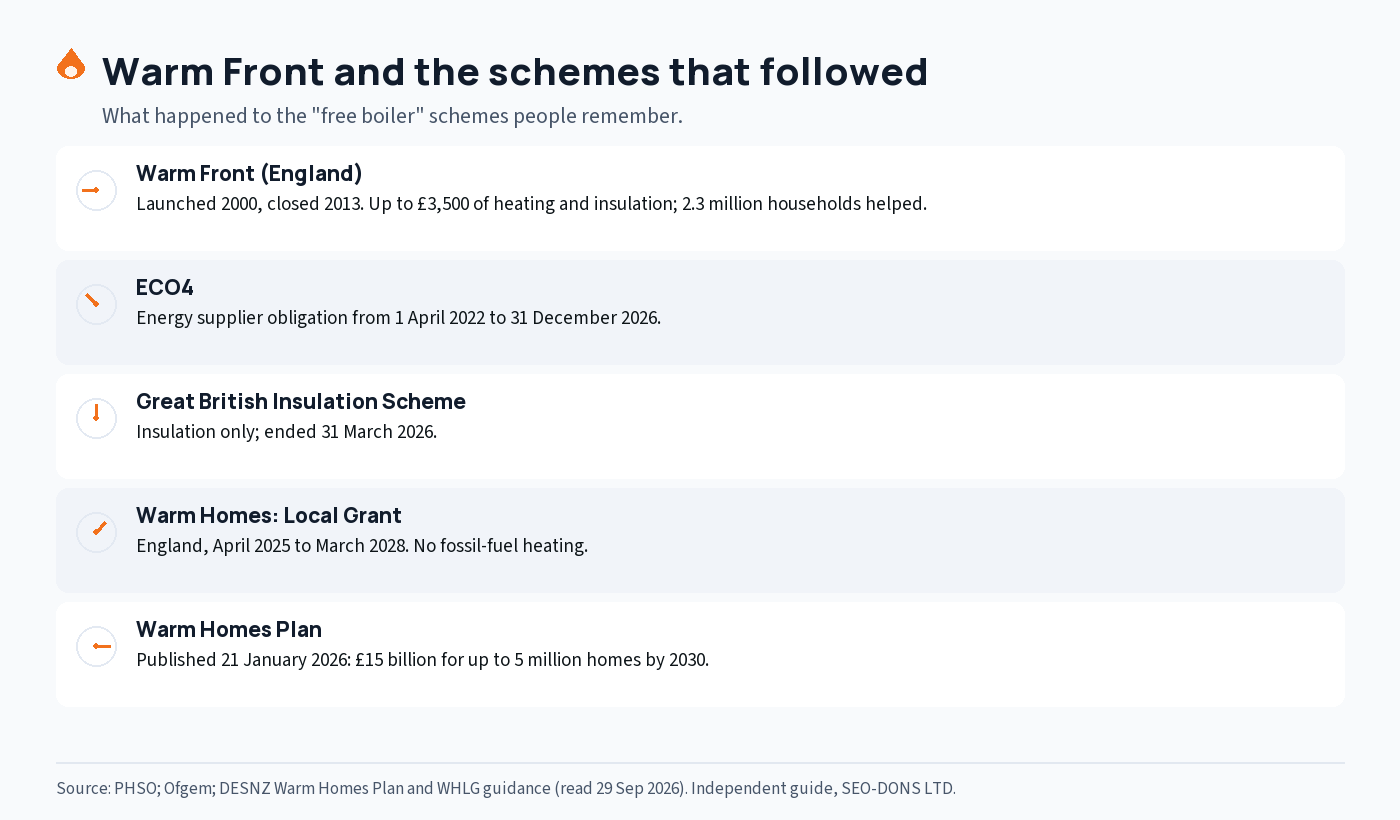
Many people searching for a free boiler remember Warm Front. The Parliamentary and Health Service Ombudsman’s account of the scheme says it “was launched in 2000” as “a government scheme intended to help people on low incomes living in properties with poor insulation or without a working heating system”. Eligible households “could get up to £3,500 worth of improvements”, and, citing the House of Commons Library, “2.3 million households received help”. It covered England, and “in 2013 the Warm Front scheme was closed”.
That is the origin of the idea that “the government gives out free boilers”: for over a decade, a directly funded government scheme did pay for heating for low-income households.
What came after
Help shifted from a government-funded scheme to an obligation on energy suppliers, the Energy Company Obligation (ECO). Under its earlier phases, suppliers had a Home Heating Cost Reduction Obligation aimed at low-income, vulnerable households; Ofgem’s guidance referred to them as the Affordable Warmth group, which is why that phrase still circulates (see Affordable Warmth scheme).
The current phase, ECO4, applies to measures installed from 1 April 2022 and runs until 31 December 2026 after a nine-month extension. It can repair, replace or upgrade boilers for eligible households in England, Scotland and Wales. Its rules are in the ECO4 boiler grant guide.
Alongside it:
- The Great British Insulation Scheme covered insulation only and ended on 31 March 2026.
- The Warm Homes: Local Grant in England runs April 2025 to March 2028 through councils. It funds insulation and low-carbon heating but not fossil-fuel boilers.
- The Warm Homes Plan, published on 21 January 2026, sets out £15 billion of support for up to 5 million homes by 2030.
What this means for you now
The era of a single, government-run “free heating” scheme in England ended in 2013. Today, a funded gas boiler depends on ECO4 before 31 December 2026, or on a devolved scheme if you live in Scotland, Wales or Northern Ireland. The 2026 status page tracks what is open, and the boiler grants comparison shows every current route.
A boiler fitted in the Warm Front years may now be due. Boilers installed around the time Warm Front was running may pre-date the Energy Saving Trust's condensing cut-off (gas boilers installed after 2005 are condensing). If yours is non-condensing, it is the kind that uses the most gas and the kind ECO4 upgrades without a cap.
The dates that matter
- 31 December 2026ECO4 ends after a nine-month extension. Suppliers need time to survey and install before then.Source: Ofgem
- October 2026Warm Home Discount reopens £150 off electricity for winter 2026 to 2027. Not a boiler.Source: GOV.UK
- March 2027BUS off-gas top-up ends the extra £1,500 for heat pumps replacing oil or LPG.Source: GOV.UK
- 31 March 20270% VAT on heat pumps ends then 5%. Boilers you pay for are not zero-rated.Source: HMRC
- March 2028Warm Homes: Local Grant window closes England's council scheme (April 2025 to March 2028).Source: DESNZ
Before you agree to any work
- Ask which scheme is paying, and get the funding confirmed in writing before work starts.
- Check the business on the TrustMark register and the engineer on the Gas Safe Register.
- ECO boiler replacements must come with a warranty of at least two years; repairs at least one year. Keep the paperwork.
- You are under no obligation to accept a quote, a survey or a heat pump you did not ask for.
Old scheme questions
A leaflet says I can still apply to Warm Front.
Warm Front closed in 2013. Anyone offering it today is using an old name. Ask which current scheme would pay for the work, and check the business on the TrustMark register.
I had a Warm Front boiler years ago. Can I get another free one?
A past grant does not stop you applying to today's schemes, but you must meet their rules. Under ECO4 a boiler fitted under Warm Front may now be old enough to be non-condensing, which would make it eligible for the uncapped upgrade route if your household qualifies.
Questions people ask
Does the Warm Front scheme still exist?
No. The Parliamentary and Health Service Ombudsman records that the Warm Front scheme was launched in 2000 and closed in 2013.
What did Warm Front pay for?
Heating and insulation improvements for people on low incomes living in poorly insulated homes or without a working heating system, up to £3,500 per household.
What replaced Warm Front?
Supplier-funded help under the Energy Company Obligation, now in its fourth phase (ECO4) until 31 December 2026. England also has the council-run Warm Homes: Local Grant for low-carbon measures.
Is there a new government boiler scheme to replace ECO4?
We have not found a confirmed replacement supplier obligation in the sources we read. The Warm Homes Plan, published on 21 January 2026, sets out £15 billion of support, but the England grant it funds does not pay for fossil-fuel boilers.
Sources
- Parliamentary and Health Service Ombudsman, Background to the Warm Front scheme (read 29 September 2026)
- Ofgem, Energy Company Obligation (ECO) (read 29 September 2026)
- Ofgem, ECO: monitoring regime for Affordable Warmth Group (AWG) members (30 July 2014) (read 29 September 2026)
- DESNZ, Warm Homes Plan (published 21 January 2026, updated 18 March 2026) (read 28 September 2026)
- DESNZ, Warm Homes: Local Grant policy guidance for local authorities (July 2026) (read 29 September 2026)
- TrustMark, Find a registered tradesperson (read 29 September 2026)
- Energy Saving Trust, Boiler types explained (last updated 20 May 2026) (read 29 September 2026)
Ask for a second opinion or quotes
Tell us your situation. We pass your enquiry to independent heating firms or scheme delivery partners that cover your postcode; they tell you whether a funded route is open to you, or quote if it is not. We cannot decide eligibility (suppliers and councils do), and you can always apply to the official schemes directly. There is no charge for this.
What happens next
- We read your enquiry and check which kind of firm can help.
- We pass it to relevant independent firms that cover your postcode.
- They contact you with questions or a quote. You compare, and decide — with no obligation to go ahead.