Affordable Warmth scheme: which one people mean in 2026
Two things share one name
“Affordable Warmth” means two different things depending on where you are and what you are reading, and mixing them up is behind a lot of confused searches.
- Northern Ireland’s Affordable Warmth scheme is a live grant for private homes, run by the Department for Communities and delivered by the Northern Ireland Housing Executive with local councils.
- “Affordable Warmth” in Great Britain was used under earlier phases of the Energy Company Obligation for the low-income households the scheme targeted. Ofgem’s 2014 guidance, for example, refers to evidencing “Affordable Warmth Group eligibility” under the Home Heating Cost Reduction Obligation. It is not a separate scheme you can apply to today; the live equivalent is ECO4.
Affordable Warmth in Northern Ireland
The Department for Communities’ published description of the scheme:
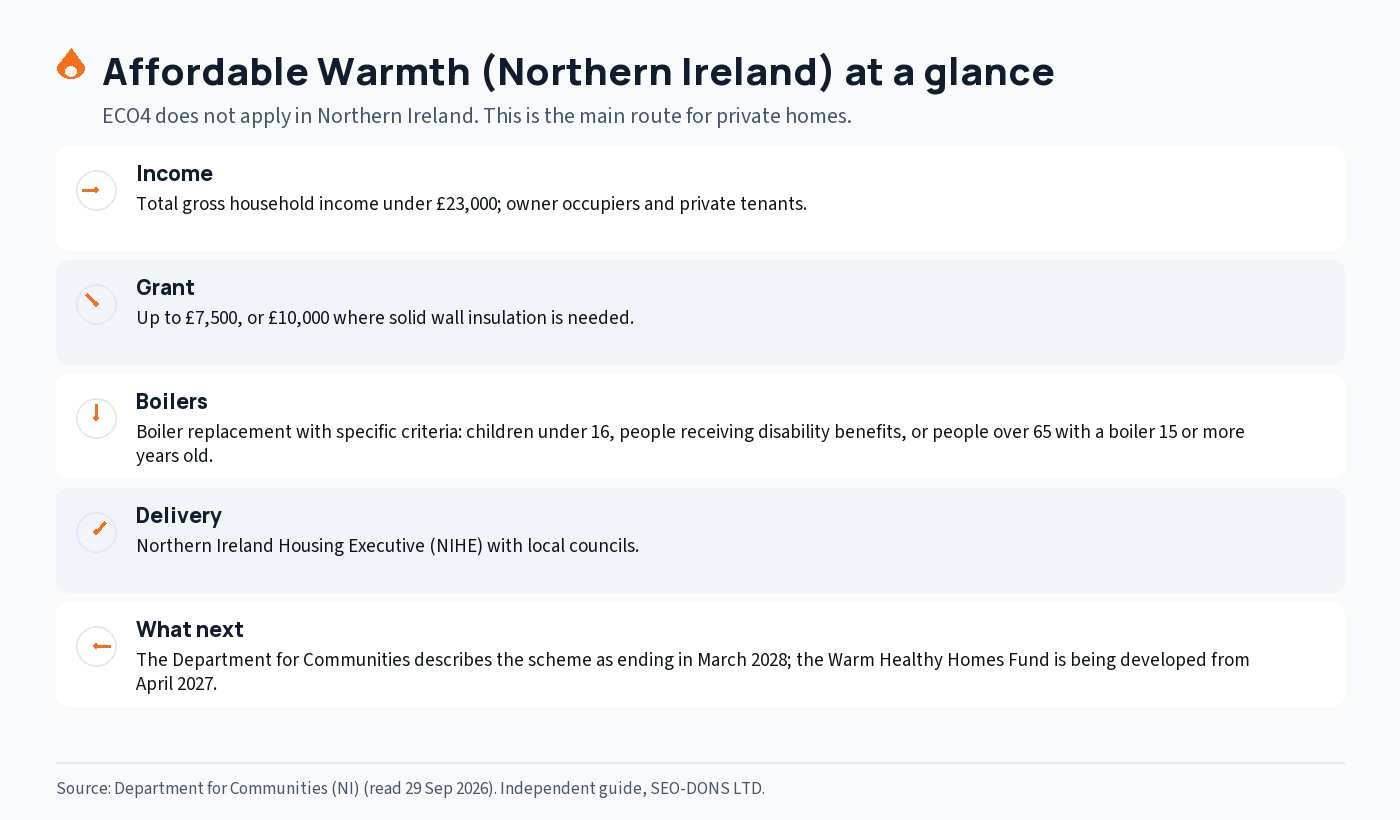
- total gross annual household income of less than £23,000;
- for owner occupiers and private tenants;
- grants of up to £7,500, or £10,000 where solid wall insulation is required;
- measures including loft and cavity wall insulation, heating installation and upgrades, single-glazed window replacement, solid wall insulation and boiler replacement;
- boiler replacement with specific criteria for households with children under 16, people receiving disability benefits, or people over 65 whose boiler is 15 or more years old.
Its future: the Department is developing the Warm Healthy Homes Fund to become its main fuel poverty and energy efficiency intervention for private homes from April 2027, and its screening document for the fund describes Affordable Warmth as ending in March 2028. The full Northern Ireland picture, including why ECO4 and the Warm Home Discount do not apply, is on our Northern Ireland page.
“Affordable Warmth” in Great Britain
Under earlier ECO phases, suppliers had a Home Heating Cost Reduction Obligation aimed at low-income, vulnerable households, and the eligible group was known as the Affordable Warmth group. That is why some energy companies and installers still use “Affordable Warmth” on their pages. Today, the live scheme is ECO4, which Ofgem says runs until 31 December 2026. If someone offers you an “Affordable Warmth boiler” in England, Scotland or Wales, they almost certainly mean ECO4, and the ECO4 boiler grant guide explains its rules: an old non-condensing boiler can be replaced as an uncapped upgrade, while a modern broken boiler is replaced only if it cannot be economically repaired.
Which one applies to you
- Northern Ireland: Affordable Warmth, if your gross household income is under £23,000. See Northern Ireland.
- England, Scotland or Wales: ECO4 until 31 December 2026, plus Warmer Homes Scotland or Nest if you live there. See boiler grants compared.
For the history of the older schemes, including Warm Front, see Warm Front and the schemes that followed.
Why the grant cap matters. Affordable Warmth's £7,500 cap covers a package of measures, not just a boiler. The Energy Saving Trust gives £3,200 as a typical cost to replace a G-rated oil boiler with an A-rated one in Northern Ireland, which leaves room in the cap for insulation that cuts the heat the home needs.
Before you agree to any work
- Ask which scheme is paying, and get the funding confirmed in writing before work starts.
- Check the business on the TrustMark register and the engineer on the Gas Safe Register.
- ECO boiler replacements must come with a warranty of at least two years; repairs at least one year. Keep the paperwork.
- You are under no obligation to accept a quote, a survey or a heat pump you did not ask for.
Affordable Warmth questions
A company in England says it can get me an Affordable Warmth boiler.
In England, Scotland and Wales, the live supplier-funded scheme is ECO4. Older ECO phases used "Affordable Warmth" for the households the scheme targeted, so some firms still use the phrase. Ask which scheme is actually funding the work, and check the business on the TrustMark register.
Is Affordable Warmth in Northern Ireland ending?
The Department for Communities is developing the Warm Healthy Homes Fund to take over as its main scheme for private homes from April 2027, and its screening document describes Affordable Warmth as ending in March 2028.
Questions people ask
What is the Affordable Warmth scheme?
In Northern Ireland, a Department for Communities grant delivered by the Housing Executive with councils, for owner occupiers and private tenants with gross household income under £23,000. In Great Britain, a term used under earlier ECO phases for the low-income households the scheme targeted.
Does Affordable Warmth pay for a new boiler?
In Northern Ireland it includes boiler replacement for households with children under 16, people receiving disability benefits, or people over 65 with a boiler 15 or more years old, within the income limit.
How much is the Affordable Warmth grant?
Up to £7,500, or £10,000 where solid wall insulation is needed.
Is there an Affordable Warmth scheme in England?
Not as a separate live scheme. The equivalent supplier-funded help in England, Scotland and Wales is ECO4, which runs until 31 December 2026.
Sources
- Department for Communities (NI), Changes to the Affordable Warmth Scheme (read 29 September 2026)
- Department for Communities (NI), Warm Healthy Homes Fund (read 29 September 2026)
- Department for Communities (NI), Warm Healthy Homes Fund (replacing Affordable Warmth Scheme ending in March 2028): screening (read 29 September 2026)
- Ofgem, ECO: monitoring regime for Affordable Warmth Group (AWG) members (30 July 2014) (read 29 September 2026)
- Ofgem, Energy Company Obligation (ECO) (read 29 September 2026)
- GOV.UK, Energy Company Obligation (read 29 September 2026)
- Energy Saving Trust, Boiler types explained (last updated 20 May 2026) (read 29 September 2026)
Ask for a second opinion or quotes
Tell us your situation. We pass your enquiry to independent heating firms or scheme delivery partners that cover your postcode; they tell you whether a funded route is open to you, or quote if it is not. We cannot decide eligibility (suppliers and councils do), and you can always apply to the official schemes directly. There is no charge for this.
What happens next
- We read your enquiry and check which kind of firm can help.
- We pass it to relevant independent firms that cover your postcode.
- They contact you with questions or a quote. You compare, and decide — with no obligation to go ahead.