Is a new boiler worth it? When replacing pays, and when it does not
The one test that answers most of it
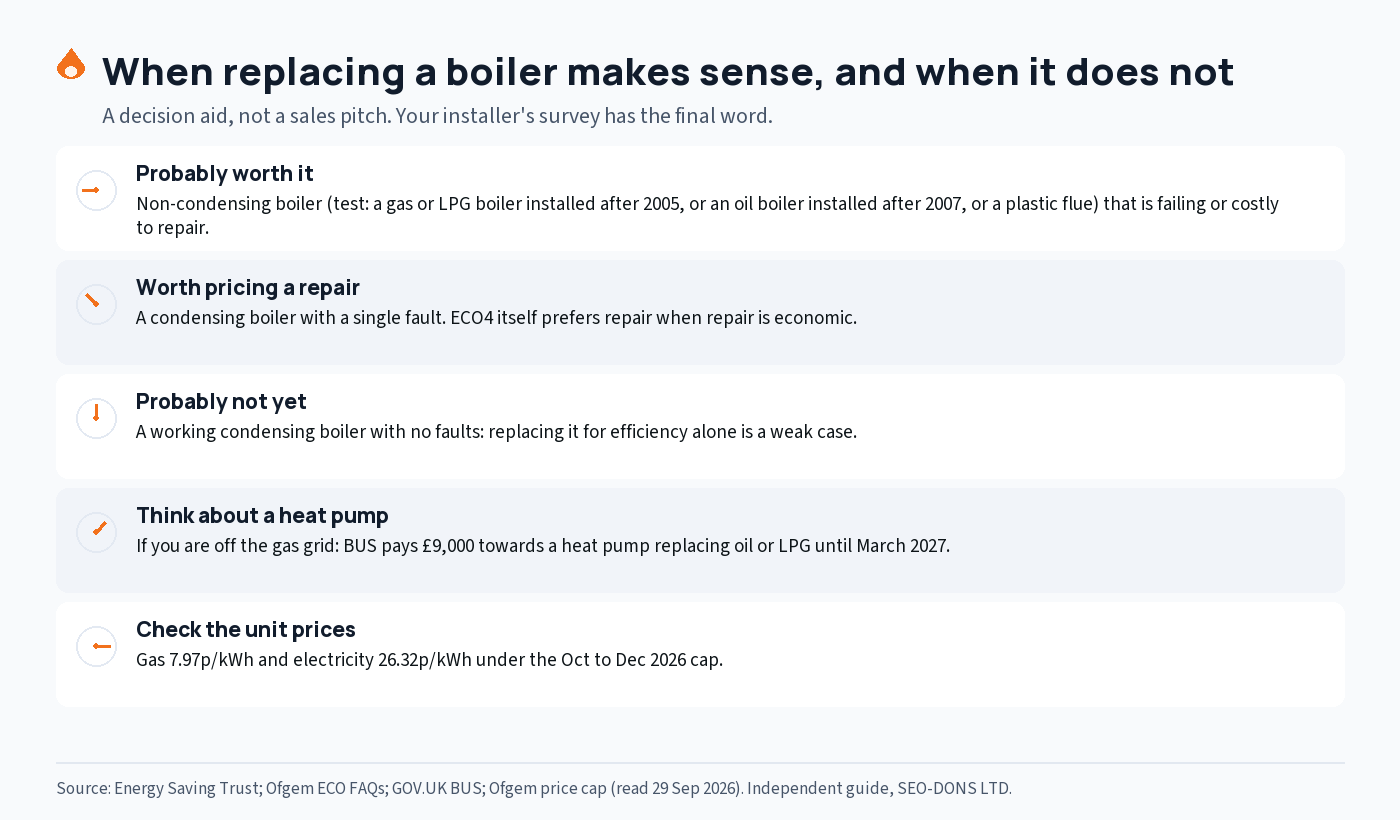
Whether a new boiler is worth the money comes down mainly to one fact: is your current boiler condensing? Condensing boilers recover heat from their exhaust gases that older boilers send up the flue. The Energy Saving Trust gives the test: your boiler is condensing if the flue is plastic, or if it is a gas or LPG boiler installed after 2005, or an oil boiler installed after 2007.
- Non-condensing and failing: replacing it is usually worth it, and if you qualify, ECO4 treats it as an uncapped “heating system upgrade”. See free boiler replacement.
- Condensing with a single fault: price a repair first. ECO4 itself only replaces an efficient boiler that “cannot be economically repaired”.
- Condensing, working, no faults: replacing it for efficiency alone is a weak case.
Doing the sum honestly
The payback on a new boiler is simple arithmetic: installed price divided by the annual saving. The installed price is the easy part. Heatable’s 2026 guide puts a like-for-like combi swap at £1,800 to £3,500, with a median quote of £2,300. The new boiler cost guide covers other job types.
The saving is where claims get inflated. It depends on how much gas you use (your annual statement gives the kWh) and how much less gas the new boiler would use in your home. At the Ofgem cap for October to December 2026, each kWh of gas costs 7.97p, plus a 29.68p daily standing charge you pay regardless. The estimator on this page lets you enter your own gas use and your own assumption for the saving, so the payback reflects your house rather than a brochure. If an installer quotes a saving, ask how they worked it out.
When it is clearly worth it
- The boiler is non-condensing and needs a repair that costs a meaningful share of a new one.
- Parts are no longer available and an engineer has written that it cannot be economically repaired.
- A Gas Safe engineer has declared it unsafe.
- You qualify for ECO4, Warmer Homes Scotland, Nest or Affordable Warmth, so most or all of the cost may be covered. The boiler grants comparison shows which applies where.
When it probably is not
- A working condensing boiler with no faults. A newer model changes relatively little.
- You are planning a heat pump in the next few years anyway. Buying a new gas boiler now commits you to it for its working life.
- The quote depends on a headline saving you cannot check.
The heat pump question
If you are off the gas grid, or will not qualify for a funded boiler, compare a heat pump before committing. The Boiler Upgrade Scheme pays £7,500 towards an air source or ground source heat pump in England and Wales, or £9,000 where you replace oil or LPG with no mains gas, until March 2027. Heat pump installation also carries 0% VAT until 31 March 2027, whereas a boiler you pay for is charged at the standard rate. Our boiler or heat pump guide sets out the numbers.
Think of it as a running-cost decision, not a shopping one. A boiler is paid for twice: once when it is fitted and every winter in gas. A cheap boiler that wastes gas can cost more over its life than a dearer, efficient one; an efficient boiler that still works is often cheaper to keep. Put your own figures in the estimator before you decide.
Estimate the cost if no grant pays
Price bands: Heatable, updated 25 September 2026. Gas: 7.97p/kWh plus 29.68p/day (Ofgem cap, 1 October to 31 December 2026; rates change quarterly). 12,000 kWh and 10% are only examples: use your own annual statement and ask each installer for their estimate of the saving. The payback uses the middle of the price range.
If no scheme pays: the ways people actually fund a boiler
Pay for it and compare three quotes
The median combi swap quote in Heatable's January to June 2026 sample was £2,300. The Energy Saving Trust recommends getting at least three quotes from different installers.
Ask about 5% VAT
Grant-funded heating work for someone aged 60 or over, or receiving one of the benefits listed in the notice, where the work is grant-funded is charged VAT at 5% instead of the standard 20% (HMRC VAT Notice 708/6).
Spread the cost carefully
If an installer offers monthly payments, it is a credit agreement: check the lender on the FCA register and compare the APR and total repayable, not just the monthly figure.
Consider a heat pump grant
The Boiler Upgrade Scheme pays £7,500 towards a heat pump in England and Wales, with no income test, and heat pump installation carries 0% VAT until 31 March 2027.
Scotland: interest-free help
Where Warmer Homes Scotland needs a contribution, Home Energy Scotland says it can be covered by an interest-free loan managed by Energy Saving Trust, subject to credit checks.
Price a repair first
A single fault on a condensing boiler is often a repair job. ECO4 itself only replaces an efficient boiler when it cannot be economically repaired.
Before you agree to any work
- Ask which scheme is paying, and get the funding confirmed in writing before work starts.
- Check the business on the TrustMark register and the engineer on the Gas Safe Register.
- ECO boiler replacements must come with a warranty of at least two years; repairs at least one year. Keep the paperwork.
- You are under no obligation to accept a quote, a survey or a heat pump you did not ask for.
Honest concessions
Will a new boiler cut my bills in half?
Be sceptical of any headline saving. The saving depends on how inefficient the old boiler is and how much gas the home uses. A working condensing boiler replaced by a newer condensing boiler changes little. Ask the installer to estimate your saving, and test it in the estimator on this page.
My engineer says my boiler is 'getting on'. Should I replace it now?
Age alone is not a reason. Ask what is wrong with it, what a repair would cost and whether parts are still available. If it is condensing and safe, a service or repair can be the better value.
Is it worth replacing a boiler before I sell the house?
That is a judgement about your buyers and your market, not something the schemes or cost data can answer. What you can say for sure is that a buyer's survey will note an old boiler, and that a replacement needs Gas Safe paperwork you should keep for the sale.
Questions people ask
How do I know if my boiler is inefficient?
The Energy Saving Trust says your boiler is condensing if the flue is plastic, or if it is a gas or LPG boiler installed after 2005 or an oil boiler installed after 2007. If none of those applies, it is probably non-condensing and less efficient.
Is it worth repairing an old boiler?
If it is condensing and the fault is a single part, a repair is often better value. ECO4 itself only replaces an efficient boiler when it cannot be economically repaired.
What is the payback on a new boiler?
Divide the installed price by the yearly saving. A like-for-like combi swap is typically £1,800 to £3,500 (Heatable, 2026); the saving depends on your gas use at 7.97p per kWh (Ofgem cap, October to December 2026) and how much less gas the new boiler uses. The estimator on this page does the sum with your own numbers.
Should I get a heat pump instead?
Consider it if you are off the gas grid or will not qualify for a funded boiler. The Boiler Upgrade Scheme pays £7,500 towards a heat pump (£9,000 replacing oil or LPG with no mains gas, until March 2027).
Sources
- Energy Saving Trust, Boiler types explained (last updated 20 May 2026) (read 29 September 2026)
- Ofgem, ECO FAQs for domestic consumers and landlords (read 29 September 2026)
- Heatable, New boiler installation costs 2026 (updated 25 September 2026) (read 29 September 2026)
- Ofgem, Energy price cap: standing charges and unit rates by region (read 29 September 2026)
- GOV.UK, Boiler Upgrade Scheme: what you can get (read 29 September 2026)
- HMRC, VAT Notice 708/6: energy-saving materials and heating equipment (read 29 September 2026)
Ask for a second opinion or quotes
Tell us your situation. We pass your enquiry to independent heating firms or scheme delivery partners that cover your postcode; they tell you whether a funded route is open to you, or quote if it is not. We cannot decide eligibility (suppliers and councils do), and you can always apply to the official schemes directly. There is no charge for this.
What happens next
- We read your enquiry and check which kind of firm can help.
- We pass it to relevant independent firms that cover your postcode.
- They contact you with questions or a quote. You compare, and decide — with no obligation to go ahead.