Free boiler for homeowners, tenants and landlords: who applies
Who applies depends on who owns the home
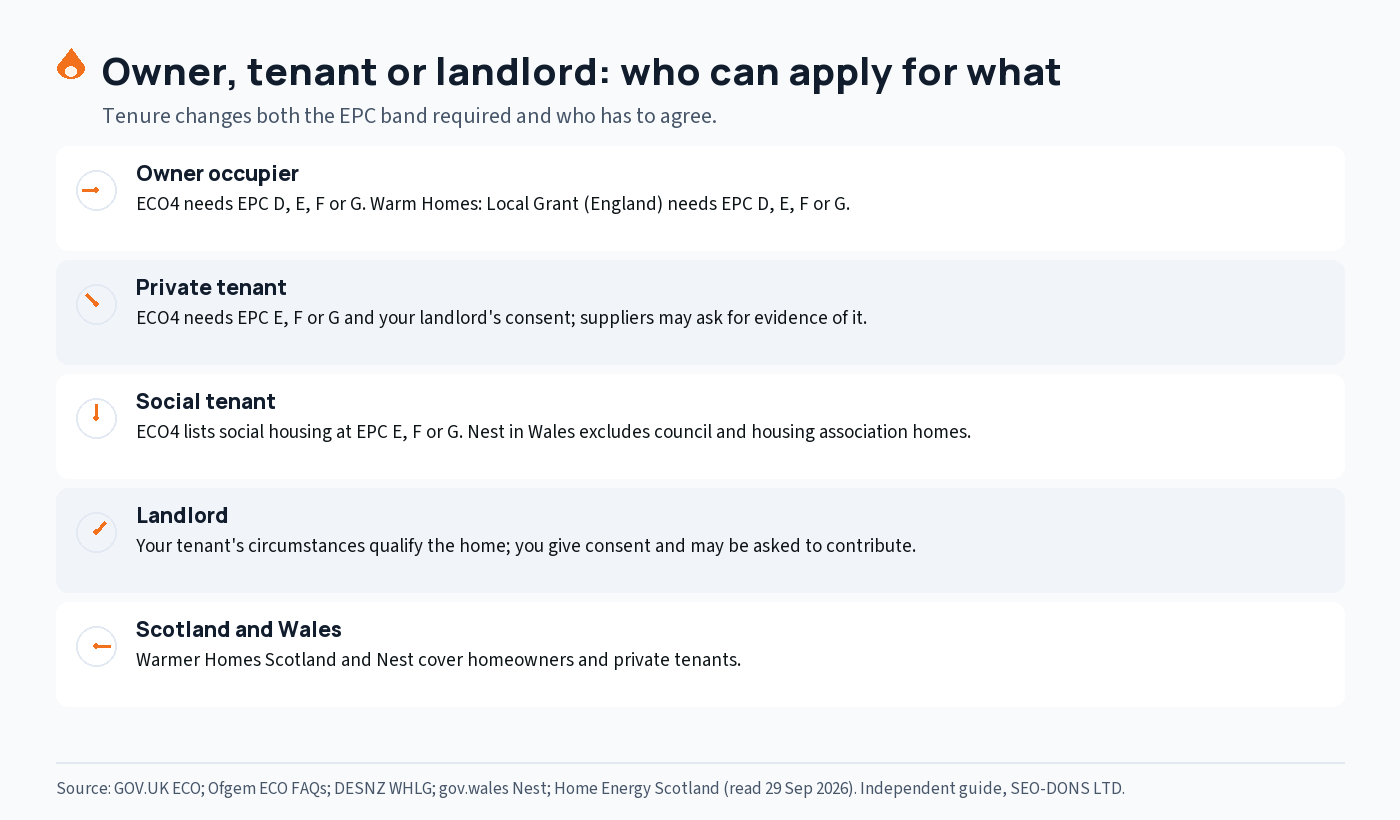
A funded boiler is a change to a building, so the owner always has a say. The schemes handle this differently for owners, private tenants, social tenants and landlords, and the EPC band required changes too.
Homeowners
Owner occupiers apply for themselves. For ECO4, GOV.UK sets the home’s energy rating at EPC D, E, F or G for owner occupiers, a wider range than for tenants. You then need a qualifying benefit or an ECO4 Flex referral, and a boiler situation the scheme can fund. The eligibility guide covers all four tests, and the ECO4 boiler grant guide the routes.
Private tenants
You can apply for ECO4 as a private tenant. The home must be rated EPC E, F or G, and, as Ofgem’s FAQ puts it, “you must gain consent from your landlord”. “Suppliers may choose to request evidence that the landlord’s permission has been obtained.” The qualifying circumstances (benefit or Flex) are yours, not the landlord’s.
In Scotland, Warmer Homes Scotland covers “the tenant of a private-sector landlord”; in Wales, Nest covers people who privately rent. In England, the Warm Homes: Local Grant covers privately rented homes too, but it funds insulation and low-carbon heating, not gas boilers.
Council and housing association tenants
GOV.UK lists social housing tenants at EPC E, F or G for ECO help, but the boiler belongs to your landlord, and social housing is improved through the landlord’s own programmes. Nest in Wales explicitly excludes local authority and housing association homes. If your heating is failing, report it to your landlord in writing and keep a copy.
Landlords
Landlords cannot qualify on their own circumstances. Eligibility comes from the tenant’s household, and the landlord’s role is to consent. Ofgem notes that suppliers decide the level of funding and “you may be asked to contribute”. Agree any contribution before work starts. A more efficient heating system can also help with minimum energy efficiency requirements for rented homes; check the current rules for your nation before relying on that.
Quick reference
| Who | ECO4 EPC band | Who applies | Devolved schemes |
|---|---|---|---|
| Owner occupier | D to G | You | Warmer Homes Scotland, Nest |
| Private tenant | E to G | You, with landlord consent | Warmer Homes Scotland, Nest |
| Social tenant | E to G | Your landlord | Nest excludes social homes |
| Landlord | E to G (tenant qualifies) | Tenant applies; you consent | Tenant-led |
For benefit rules see free boiler on benefits; for England’s routes see England; for Wales, Wales.
Who gains from the saving. In a rented home the tenant usually pays the energy bills, so a more efficient boiler mainly cuts the tenant's gas use (7.97p per kWh under the October to December 2026 cap). That is why schemes qualify the tenant's household, and why a landlord's consent is the key step.
Which boiler routes could be open to you?
Nothing you tick here is sent anywhere. The answer is a starting point based on the official rules, not a decision.
Choose your answers
Before you agree to any work
- Ask which scheme is paying, and get the funding confirmed in writing before work starts.
- Check the business on the TrustMark register and the engineer on the Gas Safe Register.
- ECO boiler replacements must come with a warranty of at least two years; repairs at least one year. Keep the paperwork.
- You are under no obligation to accept a quote, a survey or a heat pump you did not ask for.
Tenant and landlord concerns
My landlord will not agree. What can I do?
ECO4 needs your landlord's consent for work in a privately rented home, and suppliers may ask for evidence of it. Explain that the scheme is funded by energy suppliers and that a more efficient home can help the landlord with rules on minimum energy standards. If they still refuse, ask your council's private housing team for advice about the condition of the heating.
As a landlord, will I have to pay?
Possibly. Ofgem says suppliers decide the level of funding and that a contribution may be requested. Agree any contribution in writing before work starts.
My council flat's boiler is ancient. Who fixes it?
Your landlord. Report the problem to the council or housing association in writing. Social housing is improved through the landlord's own programmes, and Nest in Wales does not cover council or housing association homes at all.
Questions people ask
Can private tenants get a free boiler?
Yes, if the household qualifies for ECO4 and the home is rated EPC E, F or G, with the landlord's consent. In Scotland and Wales, Warmer Homes Scotland and Nest also cover private tenants.
Can council tenants get a free boiler?
Council and housing association homes are improved through the landlord. GOV.UK lists social housing at EPC E, F or G for ECO help, but the tenant does not apply for the boiler themselves.
Can landlords get a free boiler for a rental property?
Not on their own circumstances. ECO4 eligibility comes from the tenant's household (benefits or Flex), and the landlord gives consent. A contribution may be requested.
Can homeowners get a free boiler?
Yes, if the household qualifies on benefits or through ECO4 Flex and the home is rated EPC D, E, F or G, until ECO4 ends on 31 December 2026. Devolved schemes cover homeowners too.
Does the Warm Homes: Local Grant cover rented homes?
It covers privately owned homes, including privately rented ones, in England, but it funds insulation and low-carbon heating rather than gas boilers.
Sources
- GOV.UK, Energy Company Obligation (read 29 September 2026)
- Ofgem, ECO FAQs for domestic consumers and landlords (read 29 September 2026)
- Ofgem, ECO: homeowners and tenants (read 29 September 2026)
- GOV.UK, Apply for the Warm Homes: Local Grant (read 29 September 2026)
- DESNZ, Warm Homes: Local Grant policy guidance for local authorities (July 2026) (read 29 September 2026)
- Home Energy Scotland, Warmer Homes Scotland (read 29 September 2026)
- Welsh Government, Nest eligibility (read 29 September 2026)
Ask for a second opinion or quotes
Tell us your situation. We pass your enquiry to independent heating firms or scheme delivery partners that cover your postcode; they tell you whether a funded route is open to you, or quote if it is not. We cannot decide eligibility (suppliers and councils do), and you can always apply to the official schemes directly. There is no charge for this.
What happens next
- We read your enquiry and check which kind of firm can help.
- We pass it to relevant independent firms that cover your postcode.
- They contact you with questions or a quote. You compare, and decide — with no obligation to go ahead.