Who qualifies for a free boiler? The 2026 eligibility rules
Which boiler routes could be open to you?
Nothing you tick here is sent anywhere. The answer is a starting point based on the official rules, not a decision.
Choose your answers
The four tests, in plain English
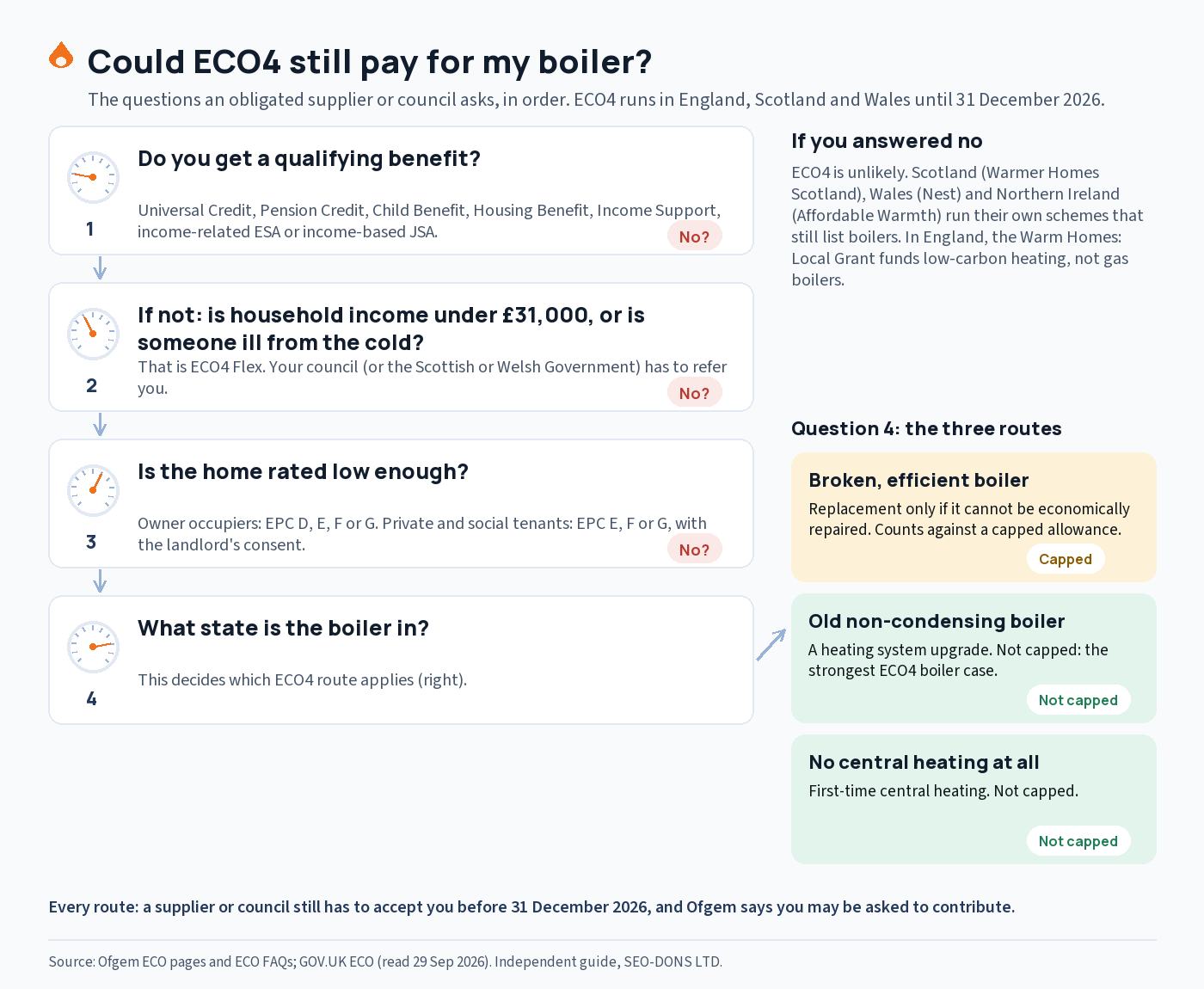
Every funded-boiler route asks some version of the same four questions. The checker above runs through them; here is what each one means and why it matters.
1. Money: a benefit, low income or a health condition
ECO4’s main door is a qualifying benefit. Ofgem lists Child Benefit, Pension Guarantee Credit, Pension Credit Savings Credit, income-related Employment and Support Allowance, income-based Jobseeker’s Allowance, Income Support, Universal Credit and Housing Benefit. One is enough. The benefits guide covers how each nation treats them.
If you are not on a benefit, ECO4 Flex offers two more routes, both of which need your council (or the Scottish or Welsh Government) to refer you:
- Income: combined gross annual household income under £31,000.
- Health: someone in the home has a severe or long-term condition (cardiovascular, respiratory, limited mobility or immunosuppression) made worse by living in a cold home.
Ask your council directly whether it is still making ECO4 Flex referrals; with the scheme ending on 31 December 2026, not all will be.
2. The home: its EPC band
GOV.UK sets the energy rating a home must have for ECO help: EPC D, E, F or G if you own and live in it, and E, F or G if you rent privately or from a social landlord. A band C or better home is outside ECO4 whatever your income. Nest in Wales uses SAP scores instead: 54 (band E) or lower, or 68 (band D) or lower when someone has an eligible health condition. Warmer Homes Scotland asks for “a poor energy rating”, which its delivery partner assesses.
3. Tenure: who owns the home
Owner occupiers apply for themselves. Private tenants can apply but need their landlord’s consent. Social tenants (council or housing association) are improved through the landlord’s own programmes, and Nest excludes their homes entirely. Full detail: homeowners, tenants and landlords.
4. The boiler: broken, old or missing
This is the test most guides skip, and it decides the route under ECO4:
- Old and non-condensing (usually a metal flue, or a gas boiler fitted before 2005 according to the Energy Saving Trust): replaced as a “heating system upgrade”, which is not capped.
- Modern and broken down: replaced only if it “cannot be economically repaired”, and counted against a capped allowance. A repair may be offered instead.
- No central heating at all: first-time central heating, also outside the cap.
The ECO4 boiler grant guide explains the cap and the warranties that come with each route.
Eligibility outside England
The tests change once you cross a border, and in some ways they become more generous for boilers:
- Scotland: Warmer Homes Scotland is for homeowners and private tenants who have lived in the home for at least six months, in a home of 230 m² or less in council tax bands A to G, where someone is aged 75 or over with no working heating, holds certain medical certificates, or receives one of 15 passport benefits. See Scotland.
- Wales: Nest is for people who own or privately rent, receive a means-tested benefit or live in a low-income household, in a home at or below the SAP thresholds above. Without an eligible health condition you may be placed on a reserve list. See Wales.
- Northern Ireland: ECO4 does not apply. Affordable Warmth is for owner occupiers and private tenants with total gross household income under £23,000. See Northern Ireland.
If the checker says no
A “no” for ECO4 is common and not the end of the road. In England the Warm Homes: Local Grant has a higher income limit (£36,000 or less, or a qualifying postcode or benefit) but only funds low-carbon heating and insulation. The Boiler Upgrade Scheme has no income test at all and pays £7,500 towards a heat pump. And if you simply need a boiler, the new boiler cost guide shows typical prices and how to compare quotes.
Why the boiler test matters to your bill, too. A non-condensing boiler is the one most worth replacing on running costs as well as eligibility. At the October to December 2026 cap, every kWh of gas costs 7.97p; ask an installer to estimate how much less gas a condensing boiler would use in your home.
Before you agree to any work
- Ask which scheme is paying, and get the funding confirmed in writing before work starts.
- Check the business on the TrustMark register and the engineer on the Gas Safe Register.
- ECO boiler replacements must come with a warranty of at least two years; repairs at least one year. Keep the paperwork.
- You are under no obligation to accept a quote, a survey or a heat pump you did not ask for.
Eligibility worries
I am on benefits. Does that mean I will definitely get a boiler?
It means you pass the first test, not that you get a boiler. The home must also be rated low enough on its EPC, a retrofit assessment has to agree the work, and a supplier or council has to have capacity. Ofgem says suppliers choose which measures they fund and at what level, and that you may be asked to contribute.
I do not have an EPC. Can I still apply?
You can still ask. ECO4 work starts with a retrofit assessment of the home, and the devolved schemes assess the property too. Ask the supplier, council or scheme adviser how they will establish the rating if there is no certificate on the register.
I earn just over £31,000. Is there any point?
For ECO4 Flex's income route, probably not, but the health route has no income figure: it is for households where someone has a severe or long-term condition made worse by a cold home. In Wales, Nest's income thresholds vary by household size and are measured after mortgage or rent. In Scotland, age and medical routes exist.
Questions people ask
Who is entitled to a free boiler in the UK?
No one is automatically entitled. Eligibility depends on the scheme: ECO4 needs a qualifying benefit or a council Flex referral (income under £31,000 or a cold-related health condition) plus an EPC band of D to G for owners or E to G for tenants. Warmer Homes Scotland, Nest in Wales and Affordable Warmth in Northern Ireland each have their own tests.
Which benefits qualify for a free boiler?
For ECO4, Ofgem lists Child Benefit, Pension Guarantee Credit, Pension Credit Savings Credit, income-related ESA, income-based JSA, Income Support, Universal Credit and Housing Benefit. See the benefits page for how each nation treats them.
Can I get a free boiler if I work?
Yes, if your household still qualifies: for example Universal Credit paid alongside work counts, and ECO4 Flex's income route looks at combined gross household income under £31,000.
Does my boiler have to be broken?
No, and a broken modern boiler is actually a weaker case. Under ECO4 an old non-condensing boiler can be replaced as an uncapped heating system upgrade, while an efficient boiler that has broken down is only replaced if it cannot be economically repaired, within a cap.
Do I need permission from my landlord?
Yes. Private tenants need the landlord's consent, and Ofgem says suppliers may ask for evidence of it. Council and housing association tenants are improved through their landlord.
Sources
- Ofgem, ECO: homeowners and tenants (read 29 September 2026)
- Ofgem, ECO FAQs for domestic consumers and landlords (read 29 September 2026)
- GOV.UK, Energy Company Obligation (read 29 September 2026)
- Ofgem, Energy Company Obligation (ECO) (read 29 September 2026)
- Home Energy Scotland, Warmer Homes Scotland (read 29 September 2026)
- Welsh Government, Nest eligibility (read 29 September 2026)
- Department for Communities (NI), Changes to the Affordable Warmth Scheme (read 29 September 2026)
- GOV.UK, Apply for the Warm Homes: Local Grant (read 29 September 2026)
- Energy Saving Trust, Boiler types explained (last updated 20 May 2026) (read 29 September 2026)
Ask for a second opinion or quotes
Tell us your situation. We pass your enquiry to independent heating firms or scheme delivery partners that cover your postcode; they tell you whether a funded route is open to you, or quote if it is not. We cannot decide eligibility (suppliers and councils do), and you can always apply to the official schemes directly. There is no charge for this.
What happens next
- We read your enquiry and check which kind of firm can help.
- We pass it to relevant independent firms that cover your postcode.
- They contact you with questions or a quote. You compare, and decide — with no obligation to go ahead.